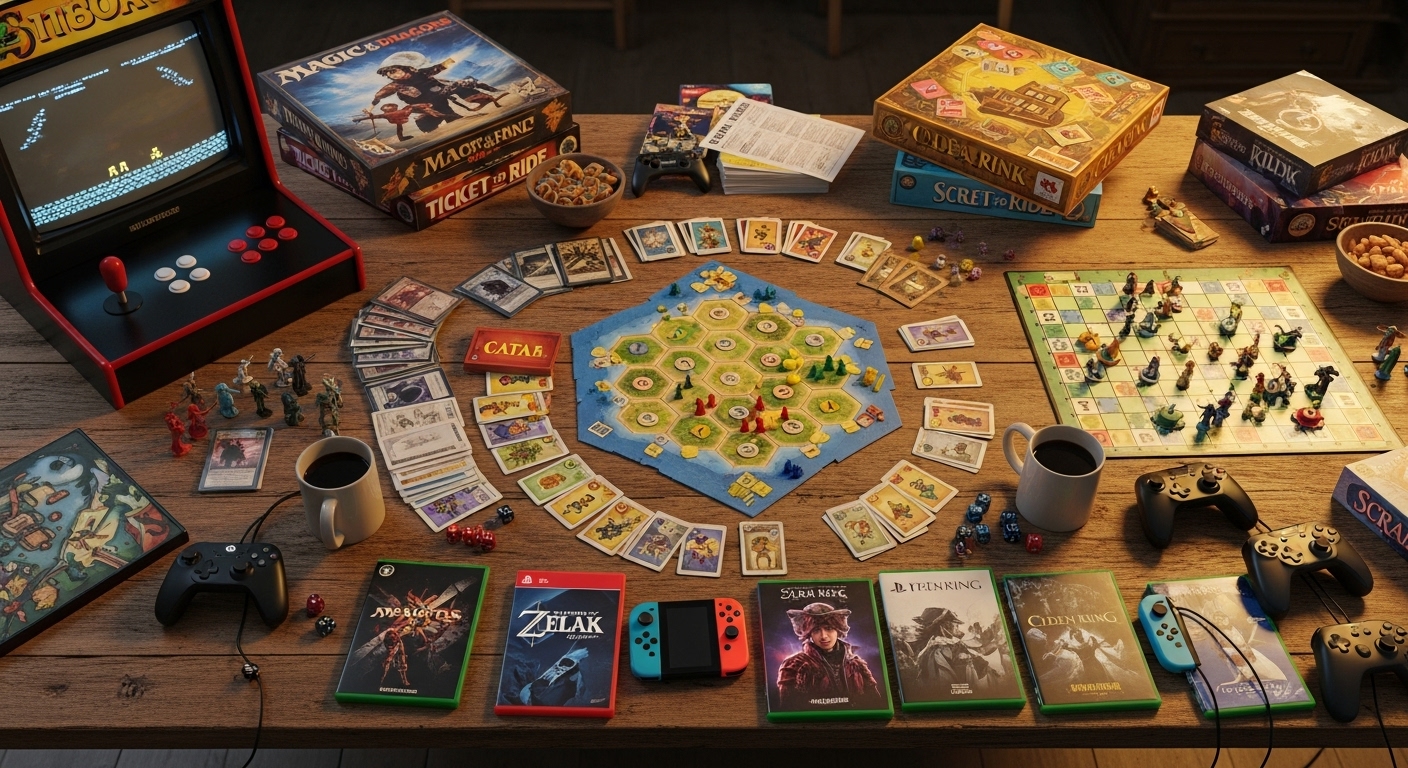

Gaming has evolved dramatically since its inception, and its transformation continues to unfold. From the days of rudimentary arcade games to the immersive virtual realities of today, the gaming world has not only become a major industry but also a cultural phenomenon. This blog post delves into the rich history of video games, the technological advances that have propelled the industry forward, and the cultural impact gaming has had on society.
The Origins of Video Games: A Humble Beginning
The story of video games begins in the 1950s and 1960s when engineers and computer scientists first began experimenting with interactive technology. Early “games” were simple experiments designed to explore the potential of computer-based entertainment.
One of the first recognized video games was Tennis for Two, developed in 1958 by physicist William Higinbotham. This simple tennis simulation, displayed on an oscilloscope, was far from a commercial product, but it set the stage for future innovations. However, it wasn’t until the early 1970s that video games started to gain traction with the public.
In 1972, Atari released Pong, one of the first commercially successful arcade games. The game was simple—a two-player tennis simulation where players used paddles to hit a ball back and forth—but it was addictive and fun, making it a hit in arcades. This success marked the beginning of the video game era, which would soon grow into a multi-billion-dollar industry. The 1970s were filled with the introduction of iconic arcade games like Space Invaders, Asteroids, and Pac-Man, each pushing the boundaries of what games could be.
The Rise of Home Consoles: Bringing Games to Your Living Room
As the 1980s approached, the video game industry began to shift from arcades to the home. The release of the Atari 2600 in 1977 marked the dawn of the home console era. The Atari 2600 allowed players to insert game cartridges into the console, offering a variety of games to choose from. While the technology was limited by today’s standards, this ability to switch games through interchangeable cartridges was revolutionary at the time.
In the years that followed, more consoles entered the market. In 1985, Nintendo launched the Nintendo Entertainment System (NES) in the United States, which became a major success. With its array of groundbreaking titles like Super Mario Bros., The Legend of Zelda, and Metroid, the NES became the console of choice for gamers around the world. It established Nintendo as a household name and helped revitalize the gaming industry after the crash of 1983, which had briefly derailed the market.
At the same time, Sega introduced its Sega Genesis console, and both companies fought for dominance in the console wars. This battle resulted in increasingly sophisticated hardware and better games. The 16-bit era ushered in titles that were larger, more detailed, and more complex than anything seen before, setting the stage for the next generation of gaming experiences.
The 3D Revolution: Entering a New Dimension
In the mid-1990s, a major leap forward in gaming technology occurred with the introduction of 3D graphics. The technological advancements of this era allowed developers to move away from 2D sprites and introduce fully realized 3D environments. This breakthrough fundamentally changed the way players interacted with games and created opportunities for new gameplay experiences.
The Sony PlayStation, released in 1994, was one of the first consoles to harness the power of 3D graphics. Its launch marked a paradigm shift in the gaming industry, as developers began to explore fully three-dimensional worlds. One of the most iconic games to showcase this new 3D capability was Final Fantasy VII, released in 1997. The game’s use of 3D environments and full-motion video helped cement the PlayStation as a revolutionary console.
Another notable 3D milestone came with the release of the Nintendo 64 in 1996. It featured an entirely new approach to platforming, as demonstrated by the groundbreaking Super Mario 64. This game was among the first to allow players to move freely in a 3D space, and it was a massive departure from the traditional 2D Mario games that had come before. The Zelda franchise also embraced 3D with the release of Ocarina of Time in 1998, which remains one of the most highly regarded games of all time.
3D technology didn’t just change the way games looked; it changed how players experienced them. Developers were now able to create vast, open worlds, intricate landscapes, and new types of gameplay that could not have existed in the 2D era. The possibilities seemed endless, and the 3D revolution would continue to shape gaming for years to come.
Online Gaming: Connecting Players Around the World
As the internet became more widespread in the late 1990s and early 2000s, the gaming industry began to shift towards online multiplayer experiences. The ability to connect with friends, or even strangers from around the world, introduced a new dimension to gaming that fundamentally changed the industry.
Microsoft’s Xbox, released in 2001, was one of the first consoles to offer a robust online service with Xbox Live. This allowed players to connect to the internet and play against each other in real-time. Games like Halo 2 became iconic for their online multiplayer modes, which offered players the chance to engage in competitive, team-based combat with others across the globe. The success of Xbox Live paved the way for other online services, such as Sony’s PlayStation Network and the Nintendo Wi-Fi Connection.
The rise of online gaming didn’t stop at console gaming. PC gaming had already been cultivating a strong online community, with games like StarCraft and Counter-Strike allowing players to engage in multiplayer matches via LAN (local area network) or online servers. The early 2000s saw the rise of massively multiplayer online role-playing games (MMORPGs) like World of Warcraft. Released in 2004, WoW became one of the most successful and influential online games of all time, drawing millions of players into its expansive world of quests, dungeons, and battles.
Online gaming ushered in a new age of social interaction in the gaming world. It allowed gamers to forge new friendships, join guilds or clans, and compete in virtual tournaments. The advent of online multiplayer gaming also laid the groundwork for the rise of esports, where players and teams now compete professionally for fame and monetary rewards.
The Mobile Gaming Explosion: Gaming on the Go
The mid-to-late 2000s marked the rise of smartphones, and with them, the rapid expansion of mobile gaming. The Apple App Store, launched in 2008, provided developers with a platform to reach millions of potential players with a wide range of mobile games. Mobile gaming introduced a new dimension to the industry, allowing players to enjoy games anywhere and anytime.
At first, mobile games were simple, casual experiences. Titles like Angry Birds and Fruit Ninja became cultural touchstones and demonstrated the potential of mobile gaming to appeal to a broad, casual audience. These games were easy to pick up, fun to play, and often free to download, making them accessible to players of all ages.
Mobile gaming expanded even further with the success of Pokémon Go in 2016. This augmented reality (AR) game blended the real world with virtual elements, allowing players to catch Pokémon in real-world locations using their smartphones. The game became a global phenomenon, bringing millions of people outside to explore their neighborhoods while playing a video game.
The rise of mobile gaming has reshaped the gaming landscape, offering a platform for both casual players and hardcore gamers. With powerful smartphones capable of running graphically intense games, mobile gaming has proven that gaming can be accessible and portable without sacrificing quality. The mobile market continues to grow, with an increasing number of developers creating innovative and engaging experiences for players on the go.
The Future of Gaming: Virtual Reality, AI, and Cloud Gaming
As we move further into the 21st century, the gaming industry continues to evolve, with new technologies pushing the boundaries of what is possible in gaming. Two of the most promising developments in the gaming world are virtual reality (VR) and cloud gaming.
Virtual Reality (VR)
Virtual reality has the potential to revolutionize gaming by offering immersive experiences that allow players to interact with digital environments in ways never before possible. VR headsets like the Oculus Rift, HTC Vive, and PlayStation VR have already begun to deliver on this promise, providing players with fully immersive 3D worlds where they can move, explore, and interact with objects as if they were actually there.
The success of games like Beat Saber and Half-Life: Alyx has demonstrated the potential of VR for both casual and hardcore gamers. VR gaming offers a completely new level of immersion, turning gaming into an experience that feels incredibly lifelike and interactive.
Cloud Gaming
Cloud gaming is another transformative technology that is changing the way we play. With cloud gaming, players can stream games from remote servers instead of running them locally on their consoles or PCs. This means that gamers no longer need high-end hardware to play the latest games, as the computing power required is provided by the cloud. Services like Google Stadia, NVIDIA GeForce Now, and Xbox Cloud Gaming are already making cloud gaming a reality.
Cloud gaming has the potential to democratize gaming, making it accessible to a wider audience. As internet speeds improve and technology advances, cloud gaming could become the dominant form of gaming, allowing players to enjoy high-quality games on any device, from smartphones to smart TVs.
Artificial Intelligence (AI)
Artificial intelligence is poised to revolutionize gaming by enabling more complex and dynamic worlds. AI-powered games will be able to adapt to a player’s actions, creating a more personalized